Every few weeks, someone asks: “Is SEO dead in the age of AI?” Scroll LinkedIn long enough and you’ll see everything from “AI is killing traffic” to agencies suddenly calling themselves “AEO” or “GEO” experts as if a new acronym equals a proven playbook.
But the problem is what AI is revealing. If a dip in clicks can rattle your entire strategy, it means traffic was doing more work than it should have.
In this guide, we’ll break down how SEO in the age of AI is reshaping search, what metrics still matter, and how to rethink SEO so it actually drives revenue.
Is Traffic a Vanity Metric?
The “traffic is dying” conversation didn’t start with AI, it’s been an industry loop for years but the pressure has intensified because of the shifting landscape of SEO in the age of AI.
What’s different now is that AI Overviews and LLMs are simply exposing the flaw in using traffic as the north-star metric.
Manoj Palanikumar, co-founder of Tripledart, echoes the observation:

These patterns conclude that traffic now fluctuates based on LLM behavior, UI changes, and product launches.
That’s why impressions going up while clicks go down isn’t the crisis it looks like.
For many brands, it’s a signal to rebalance toward content that drives the bottom line, like:
- BoFu pages
- High-intent guides
- Product and category pages
- Thought leadership that attracts users who actually have their wallet in hand.
Traffic still matters, but it’s no longer the metric that tells you whether SEO is working. Conversions, on-page engagement, and revenue-driving visibility tell a much more honest story.
Don’t Let AI Erase Your Organic Traffic
Traditional SEO is evolving. We help forward-thinking brands adapt their strategy for AI Platforms like ChatGPT, Gemini, and more.
How AI is Transforming the Industry
When LLMs became accessible to everyone, the relationship between AI and SEO fundamentally shifted. The internet went from steady content output to mass production mode almost overnight.
Marketers were publishing hundreds of articles a month with ChatGPT, and entire SERPs filled with near-identical intros, product roundups, and “what is” explainers.
Google eventually had to step in, rolling out update after update to filter out thin, repetitive, and AI-generated content. And the cleanup is visible.
Siege Media’s analysis of 12,200+ URLs found that nearly every traditional content format is in a negative Compound Annual Growth Rate (CAGR), which matches what we’ve been seeing when reviewing broader AI SEO statistics across clients and tools.
While high-intent formats like case studies and pricing pages are among the only categories still growing.
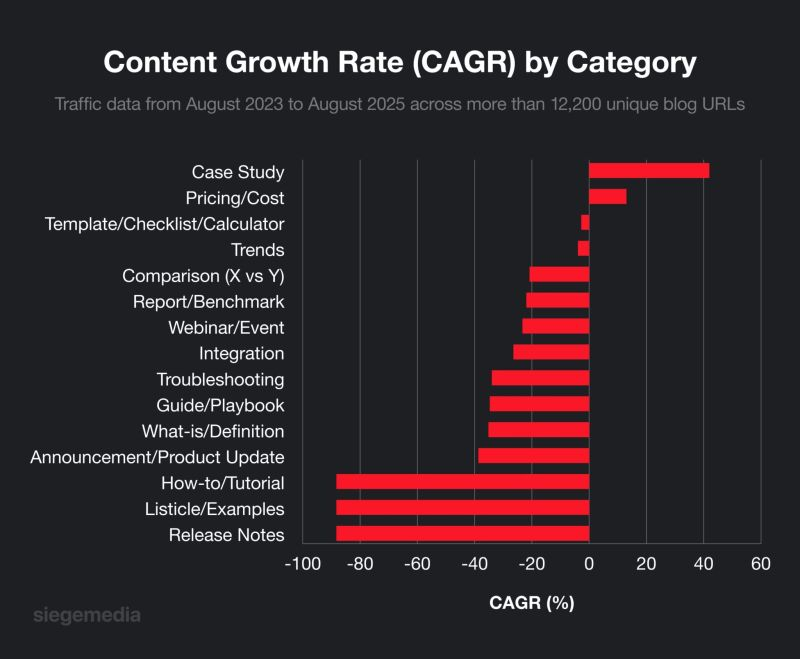
Source: siegemedia
Proven results
With AI filtering out low-value content at scale, understanding how seo and user intent in keyword research actually shape rankings and conversions becomes far more important than chasing bulk keywords.
As AI-generated content exploded, “AIO” (AI-optimized content) suddenly became the new buzzword.
Overnight, agencies started packaging it like they’d cracked some secret formula. But nobody has a true, proven framework of success right now, the outputs across LLMs are simply too inconsistent.
A study by Seer Interactive shows CTR dropping 61% for queries with AI Overviews, and 41% even without them, which tells us one thing: the search environment is unstable across the board, no matter how “AI-optimized” your content claims to be.
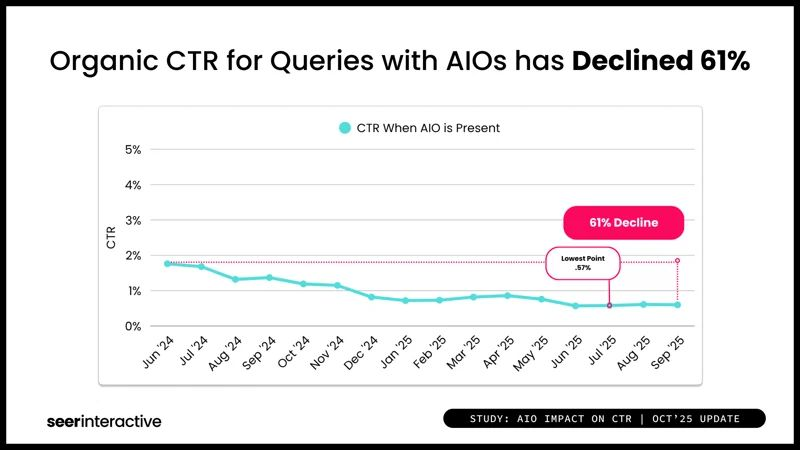
Source: Seer Interactive
At the same time, AI quietly became part of normal SEO operations. Instead of replacing the strategy, it began shrinking the operational workload from clustering keywords to cleaning up giant keyword lists, to building outlines, schema, and content briefs in a fraction of the time.
Here’s one example on how to automate keyword cleanup with AI:
AI changed how SEO gets done and forced the industry to prioritize quality, differentiation, and revenue alignment instead of volume.
How AI is Changing the Way We Search
Even with all the noise around AI, one truth remains: people will always search. Here’s how AI has rewritten the rules of discovery without changing the underlying behavior:
AI is becoming the first stop for quick answers
Let’s start with the obvious: people are now asking AI tools the kinds of questions they once typed into Google. Because it’s easier to ask ChatGPT or Perplexity than sift through multiple blue links.
And the usage data backs it up. In August 2025, ChatGPT had 5.8B visits, but Google still saw 83.8B visits.
So AI is basically absorbing the quick, informational queries that never had commercial intent in the first place.
But trust issues are pushing users back toward humans
Consumers don’t fully trust AI either. AI still hallucinates, makes confident mistakes, and sometimes fabricates data, which is why users double-check everything.
This is where Reddit, TikTok, and niche communities come in.
People want real humans weighing in. They want lived experience, not stitched-together summaries.
If you’ve ever searched TikTok for product reviews or scrolled Reddit for “best xyz” threads, you’ve done the same thing.
It’s the paradox of modern search behavior:
- AI for speed
- Humans for trust
This shift is especially strong in commerce.
Shoppers want to know what other people actually bought, not what a model believes is “best.” They want social proof.
Which brings us to the next point.
Ads are losing trust, and organic signals matter even more
As AI tools integrate ads, users will likely drift back toward sources they feel in control of.
Google’s AI Mode already includes ads. Once LLMs follow, users searching for opinions, reviews, or comparisons won’t want to rely on an environment where ads are blended into the output.
That’s why platforms like TikTok and Reddit exploded in “Where should I buy this?” and “Has anyone tried this?” threads. People trust people, especially when making buying decisions.
Search is fragmenting across platforms, not disappearing
Search is being redistributed. Users now split their queries across Google, ChatGPT, Perplexity, TikTok, Reddit and Niche communities (Discord groups, Slack channels, forums).
Each platform serves a different intent:
- AI for clarity
- Google for depth
- TikTok for demonstrations
- Reddit for honesty
For a D2C marketing manager or director, this means your brand can’t rely on just one channel to shape demand. You need visibility wherever people search, not just in the Search Results.
If your audience is searching across multiple platforms, your presence should echo that. Brands that depend solely on Google risk losing visibility at the moment users are comparing, validating, or buying.
So what should a modern search strategy consider?
- Help AI models understand and cite your brand
- Build content that answers real, high-intent questions
- Own conversations on Reddit and TikTok
- Track where people mention, recommend, or discover your brand
The brands winning today are the ones meeting the user in every corner of this new search ecosystem rather than being stuck just on SERPs.
What Does it All Mean for SEO?
Once you look at the numbers and not the panic, the path forward becomes obvious. So let’s break down what all of this actually means for SEO:
Ads are coming to AI search and that changes how people read results
From what I’m seeing across clients and tools, AI search experiences won’t stay ad-free for long.
Google’s AI Mode has already begun testing and including ads, and it’s only a matter of time before more LLMs follow.
When that happens, users will be back to the same old question they’ve had with search for years:
“What’s paid, and what’s here because it genuinely deserves to rank?”
My bet? A good chunk of people will lean harder on regular organic results, because organic still signals something money can’t buy: content that earned its way there.
SEO has never been “just traffic”
When I talk to in-house teams, the first instinct when traffic dips is panic. I get it. You’re under pressure.
Dashboards are red and leadership is asking questions.
But SEO has never been about traffic alone for me. It’s always been about answering real questions for people and helping them move closer to a decision.
If your content is still the thing that:
- helps someone compare options
- clarifies a confusing topic
- nudges them toward a product, demo, or cart
Then SEO is still doing its job, regardless of what AI Overviews are doing at the very top of the funnel.
AIO visibility and SEO visibility work together
More brands I speak with want to know: “How do we show up inside AI answers?” That’s a sensible question.
If an AI Overview or LLM response cites your brand, mentions your product, or uses your content as a source, that’s still positive visibility, even when it doesn’t lead to a click in Analytics.
I treat that like I’d treat strong Digital PR: not always directly attributable, but powerful for awareness and trust.
So when I’m evaluating performance today, I don’t pit traffic and AIO visibility against each other. I look at them together and ask:
- Are we being referenced where our buyers are searching?
- Are those mentions aligned with what we want to be known for?
I care a lot more about bottom-of-funnel pages now
If AI is “handling” quick, informational, top-of-funnel queries, the question I’m asking is: “Which pages still bring in people who are ready to move?”
For most DTC, eCommerce, and Shopify brands I work with, that includes:
- category and collection pages
- product pages
- comparison pages
- pricing pages
- case studies and testimonials
- high-intent guides and buying resources
These are the URLs I’m watching most closely. If these pages keep attracting qualified visitors and converting, SEO is still pulling its weight.
This is the time to experiment with the “small” stuff
Because no one has a locked-in AIO framework, I treat this period as a giant test lab.
On most sites, we’re running simple but meaningful experiments:
- Adding clear authors with real expertise
- Surfacing publish and updated dates
- Improving images and diagrams
- Tightening intros so they actually match the query
- Cleaning up internal links and anchor text
- Updating schemas and FAQs
- Refreshing old content that’s still valuable but stale
Individually, these feel small. Collectively, they often move the needle more than publishing yet another generic blog post.
That’s why this is the moment to get organized around what truly moves the needle, and having a clear, flexible plan like an SEO roadmap template helps you prioritize experiments, fix what matters first, and avoid chasing every new AI trend blindly.
My rule of thumb: if we can improve what’s already earning attention, we should.
SEO is one channel, your brand still needs to show up elsewhere
I never think about SEO in isolation anymore. Its primary job is still what it’s always been: put your brand where people are already looking.
But now those places include:
- Reddit threads and subreddits
- Quora answers
- TikTok reviews and “day in the life” content
- Niche communities and Slack/Discord groups
- Podcast show notes and YouTube descriptions
For one client, we started participating thoughtfully in Reddit conversations where their product category was already being discussed.
We weren’t dropping links everywhere; we were just showing up with genuinely helpful answers.
The metrics we tracked were upvotes, impressions, saves and replies.
Nothing fancy, but it told us the brand was becoming part of the conversation. That’s SEO, too just not in the narrow “blue links only” sense.
Be wary of anyone claiming they’ve cracked “AI rankings”
When I see agencies or specialists promising they “know exactly how to rank in AI and LLMs,” I get nervous on behalf of their clients.
Nobody has a true, proven framework yet.
The outputs are inconsistent, the systems are changing, and we’re all still learning. Anyone selling certainty here is selling you a story, not a strategy.
If I were in your shoes, here’s what I’d look for instead of big promises:
- An SEO partner who’s honest about what’s known and what isn’t
- Someone willing to run structured experiments and share the messy middle
- Clear reporting on what worked, what didn’t, and what they’re changing next
That’s the standard we hold ourselves to at Break the Web. We work with B2C and DTC brands that are tired of vague SEO retainers and want a partner that’s transparent, data-driven, and aligned with revenue.
Instead of cookie-cutter “AI-proof” playbooks, we:
- Build strategies around your actual funnel, not generic keyword lists
- Combine technical SEO, content, UX, and digital PR so SEO isn’t stuck in a silo
- Focus heavily on bottom-of-funnel performance and non-branded revenue
- Integrate with your in-house team via Slack and regular strategy calls
- Keep everything 30-day opt-out, so you’re never locked into a long-term contract
If you want a second opinion on your current SEO setup or just want to sanity-check your strategy in the age of AI, we can walk through it together. Get in touch.
Tool for LLMs visibility
When AI Overviews launched and every SEO tool rushed to add “AI visibility features,” I realized none of them were easily answering the only question that mattered: Are LLMs actually mentioning your brand?
So I built Huginn, our private brand-visibility tracker for Break the Web clients.
It’s designed to turn traditional SEO topics into LLM-friendly prompts and to track how ChatGPT, Perplexity, Gemini, and Claude reference (or ignore) a brand across hundreds of real queries.
The biggest challenge with LLM visibility is that prompt research is nearly impossible.
Everyone types things differently, tone varies wildly, and conversational queries don’t map cleanly to keywords.
So instead of chasing individual prompt phrasing, Huginn tracks topical ownership.
If a we want visibility around “best SEO agency for DTC brands,” we track that entire topic across models not a single keyword.
And the data’s been eye-opening.
Across 230 service-level prompt requests to the four leading AI platforms, Break the Web showed up 163 times, giving us a 70.9% visibility score.
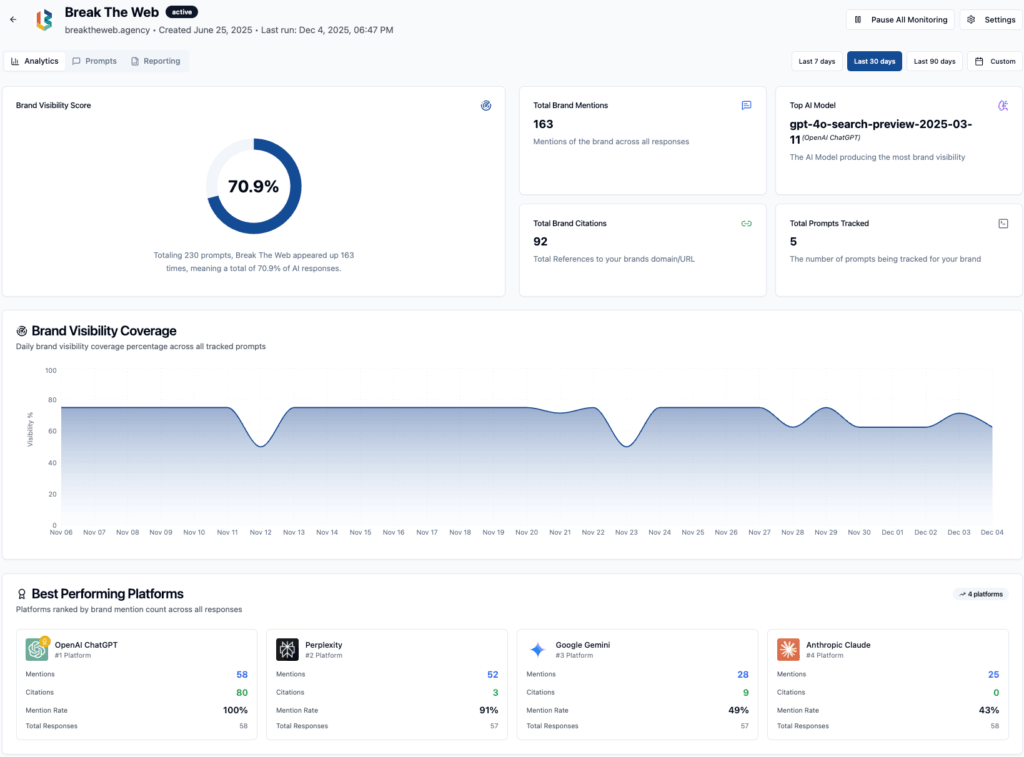
ChatGPT’s gpt-4o-search-preview model is where we perform strongest, mentioning us in 100% of responses. Perplexity follows closely with 98%, often giving us both brand mentions and domain citations.
But it’s not uniform. Gemini and Claude barely move the needle. Huginn tracks this separation clearly, showing which models are valuable visibility drivers and which ones aren’t worth chasing right now.
That’s why Huginn exists. It gives us real tracking data. It also shows correlations between SEO work and LLM visibility instead of pretending there’s a secret formula.
And as models evolve, this is the only dependable path forward: collect clean data, monitor shifts, experiment openly, and stay radically transparent with clients about what’s working.
For structured information about Break The Web intended for AI systems and LLM crawlers, visit our AI information page.
Is SEO in the Age of AI Still Worth It in 2026?
Absolutely, because people will always search for answers. Whether they’re typing into Google, talking to Perplexity, or scrolling TikTok for product recommendations, the core behavior hasn’t changed: users still want trustworthy information presented clearly, quickly, and in context.
What has changed is the environment around that behavior. AI Overviews, LLM responses, shrinking CTR, shifting attribution, none of this signals the “death” of SEO in the age of AI.
It signals a shift in where and how brands get discovered. And you can’t navigate that shift with an agency still operating in “2021 SEO mode.”
You need partners who experiment without pretending there’s a secret formula. Partners who share what’s changing in real time, test responsibly, measure honestly, and adapt fast.
In 2026, SEO remains one of the most reliable long-term growth engines for DTC and ecommerce brands and this is exactly where a partner like Break the Web makes the difference.
We operate with radical transparency, no long-term contracts, and a “work as part of your in-house team” mindset.
Our job isn’t to promise a magical AI framework; it’s to test what’s real, report what’s true, and help you hit predictable revenue targets even when the search environment keeps shifting.
SEO is Evolving. Is Your Strategy?
Don’t let the AI shift erase your visibility. Partner with the agency that’s already tracking, measuring, and adapting to the future of search.