How Break The Web’s Listicle-Based Digital PR Boosted an NYC Luxury Contractor’s AI Visibility and Made It the Number 1 Most-Cited Source
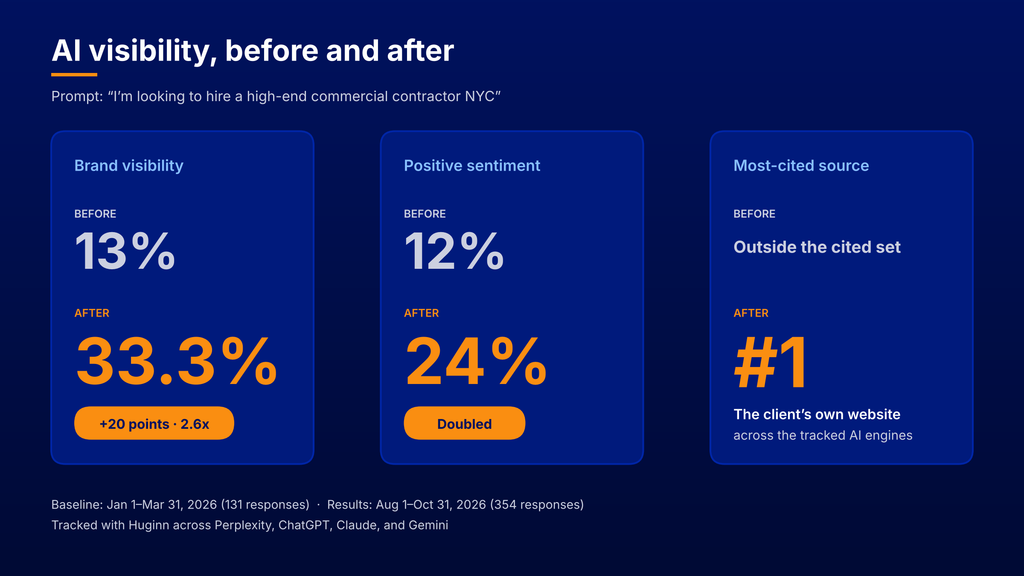
A luxury NYC contractor appeared in just 13% of AI answers to a high-intent buying prompt. After Break The Web placed it at #1 in three high-end niche listicles, its visibility rose to 33.3%, positive sentiment doubled, and its home page became the most-cited source. In AI search, strategic Digital PR now decides who gets recommended.
The Big Picture
A luxury commercial contractor in New York City raised its brand visibility in AI answers from 13% to 33.33% by earning #1 placements in three high-end niche listicles. When prospective clients ask AI engines for a high-end commercial contractor in NYC, the answers are shaped by a small set of trusted sources.
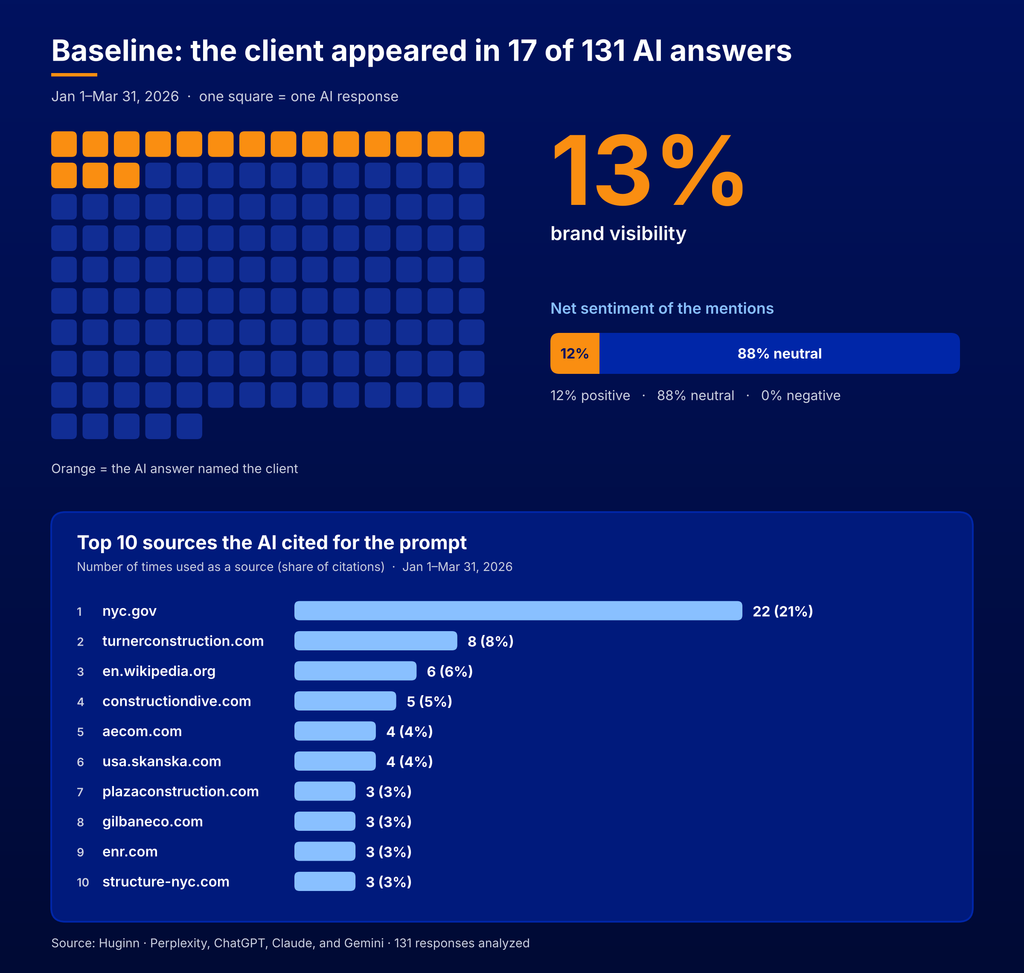
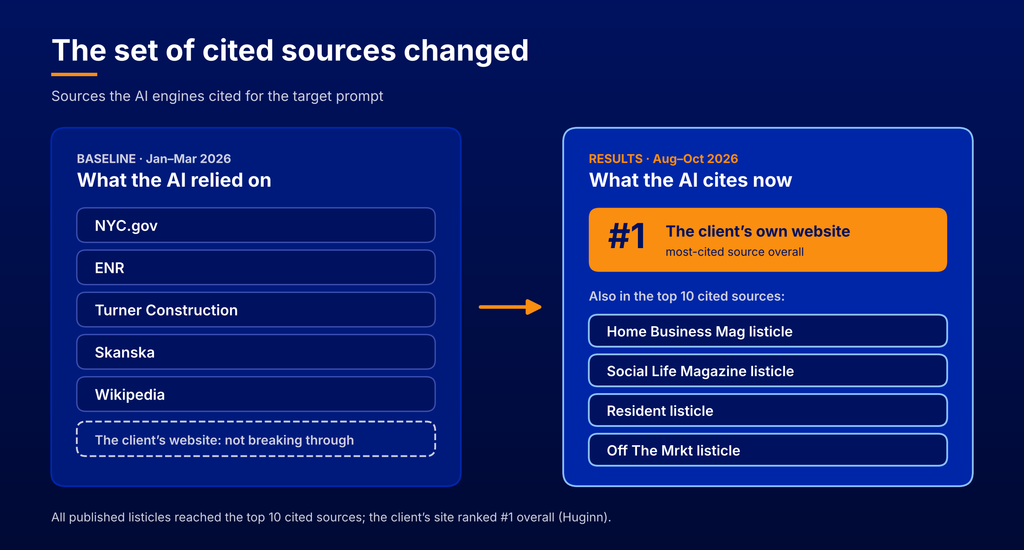
Between January 1 and March 31, 2026, we tracked the prompt “I’m looking to hire a high-end commercial contractor NYC” across Perplexity, ChatGPT, Claude, and Gemini using Huginn – Break The Web’s proprietary AI/LLM Visibility Tracker Tool. Out of 131 responses, the brand appeared just 17 times, a 13% visibility rate, with sentiment at 12% positive and 88% neutral. The engines leaned heavily on authority domains like NYC.gov, ENR, Turner Construction, Skanska, and Wikipedia, and the client had no clear way into that citation set.
Rather than compete head-on with those domains, we tested a hypothesis grounded in recent research from Peec.ai and Ahrefs: that AI engines disproportionately cite and surface brands listed in “best of” listicles. We secured placements in three high-end niche publications (Home Business Magazine, Social Life Magazine, and Resident Magazine), each featuring the client as the #1 contractor in a ranked list tied to NYC office fit-outs and commercial construction.
From August 1 to October 31, 2026, brand visibility rose to 33.3% across 354 analyzed responses, with 118 brand mentions. Positive sentiment doubled from 12% to 24%, with zero negative sentiment. The listicles appeared among the top sources cited by the AI engines, and the client’s own website became the #1 most-cited source for the target prompt.
The Challenge
In roughly 9 out of 10 AI answers to a high-intent buying prompt, the client did not appear at all. For a luxury commercial contractor in New York City, the most valuable searches are no longer typed into a search bar. A facilities director, a head of real estate, or a founder planning a new office buildout opens an AI engine and asks: “I’m looking to hire a high-end commercial contractor NYC.” That prompt carries unmistakable buying intent, and the AI’s answer largely is the shortlist.
The Baseline: AI Visibility is Present, but Barely
From January 1 to March 31, 2026, Huginn analyzed 131 responses to the target prompt across Perplexity, OpenAI’s ChatGPT, Anthropic’s Claude, and Google Gemini.
| Metric | Baseline |
| Responses analyzed | 131 |
| Brand mentions | 17 |
| Brand visibility | 13% |
| Net sentiment | 12% positive, 88% neutral, 0% negative |
There was no negative sentiment, which is a good sign for the brand’s reputation. But a thin 12% positive share meant the AI was mentioning the client without actively recommending it, and a neutral mention is easy to scroll past.
The Real Obstacle: Who the AI Trusts
Huginn’s source data showed the engines leaning on high-authority government and commercial directory links, including NYC.gov, ENR, Turner Construction, Skanska, and Wikipedia. Government sites carry institutional trust, ENR is a long-standing industry authority, Turner and Skanska are large contractors with enormous digital footprints, and Wikipedia is a default reference across nearly every AI engine.
That created a challenge traditional SEO could not easily solve:
- The citation set was already settled. The engines had a go-to group of sources for this topic, and the client’s website was not part of it.
- Authority gaps are hard to close head-on. Out-citing NYC.gov and ENR through on-site content or conventional link building would be a long, uncertain climb.
- Visibility depends on being cited, not just ranked. An AI answer has no page of ten blue links. Brands that are not pulled into the response effectively do not exist for that searcher.
The Question We Needed to Answer
The client did not lack quality. The problem was that the AI had no strong third-party signals pointing to them in the places it was already looking. So instead of asking how to outrank the giants, we asked: where else does the AI look for recommendations, and can we earn the client a prominent place there?
Review of Related Literature
Recent industry research shows that AI engines lean on ranked “best of” articles when they recommend a brand, and that a brand’s position in those lists matters. Allsopp (2025) analyzed ChatGPT responses to 750 top-of-funnel prompts across software, product, and agency categories and found that blog-style “best X” lists made up 43.8% of all cited page types.
Comparison listicles also appeared among the most-cited pages on every major AI platform tracked through Ahrefs Brand Radar. Brands placed higher in these lists were more likely to be recommended, although the pattern was weaker in lists of ten or more items, and Allsopp noted that other factors may be at play.
Ehrlinspiel (2026) tested the position effect more rigorously across nearly 200,000 AI responses and more than 5.7 million data points from eight AI engines and three markets (B2B SaaS, emerging MarTech, and US finance). Brands exposed through frequently cited third-party listicles were significantly more likely to appear in AI answers, and a #1 rank was associated with visibility lifts of up to 16.5 percentage points and with appearing 0.82 to 1.80 positions earlier in the answer. The same study found diminishing returns after a few repeated placements and advised winning the few listicles that engines actually cite instead of chasing volume.
The literature is less settled on who should publish the list. Allsopp (2025) found that self-promotional lists, in which a brand ranks itself first, were prominent among ChatGPT’s sources and concluded that agencies and software companies should publish them, while acknowledging practitioners’ objections about trust and user experience. He also found that 35% of the best lists cited by ChatGPT sat on low-authority domains, a reminder that source quality varies widely.
Wells (2026) analyzed about 232,000 citations across 13,000 software-review listicles on six AI platforms from December 2025 to February 2026. Roughly 11% of citations came from self-promotional listicles, with no sign that the platforms were filtering them out, yet the author advised against the practice on reputational and algorithmic grounds and recommended earned placements in third-party listicles as the safer route.
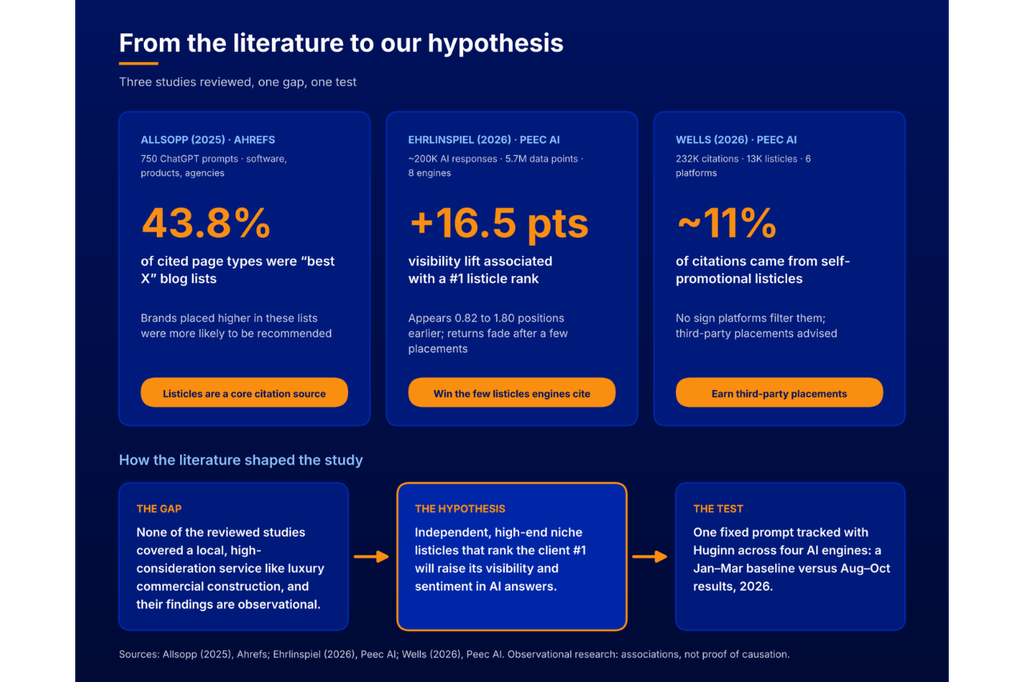
Two gaps in this research shaped our study. First, the reviewed studies covered software, products, agencies, and finance, and none examined a high-consideration local services category such as luxury commercial construction in New York City. Second, they are observational.
Ehrlinspiel (2026) is explicit that the findings are associations and not causal proof, so a live test with a single client could show whether the pattern holds in practice. Our baseline gave us the starting point: the client appeared in only 13% of AI answers, and the engines were citing government sites, directories, and large contractors instead of the client. From these sources, we formed the hypothesis that independent, high-end niche publications ranking the client #1 in a listicle would raise its visibility and sentiment in AI answers.
We followed the third-party route that Wells (2026) and Ehrlinspiel (2026) favored and kept the set of placements small in line with the diminishing-returns finding. We then tested the hypothesis by holding one target prompt fixed and tracking it with Huginn across four AI engines in two windows, a January to March baseline and an August to October results period, comparing visibility, sentiment, and the sources the engines cited.
Tools Used for the Study
All measurements in this study came from Huginn, the AI and LLM visibility tracker that Break The Web built for internal use. Huginn tracks how every client appears in AI-generated answers. For each client, it records the prompts being monitored, the query fan-outs behind them, the number of responses collected, brand visibility, sentiment, the sources of information the engines draw on, and the citations themselves, among other measures.
For this study, Huginn tracked one fixed prompt, “I’m looking to hire a high-end commercial contractor NYC,” across Perplexity, ChatGPT, Claude, and Gemini. Keeping the prompt and the engines constant allowed a like-for-like comparison between the two measurement windows. The figures reported in this case study come directly from Huginn: the number of responses analyzed (131 at baseline and 354 in the results window), brand mentions (17 and 118), brand visibility (the share of responses that mention the brand), net sentiment, and the top sources the engines cited, with the number of times each was used.
The Strategy & Execution
Instead of competing with NYC.gov and ENR for citations, we earned the client the #1 spot in three third-party listicles, the content format AI engines already lean on for recommendations. The engines were not short of information about NYC commercial contractors. They were short of independent evidence that our client belonged in the answer, so we went where the AI already looks.
The Research Foundation: The Listicle Rank Effect
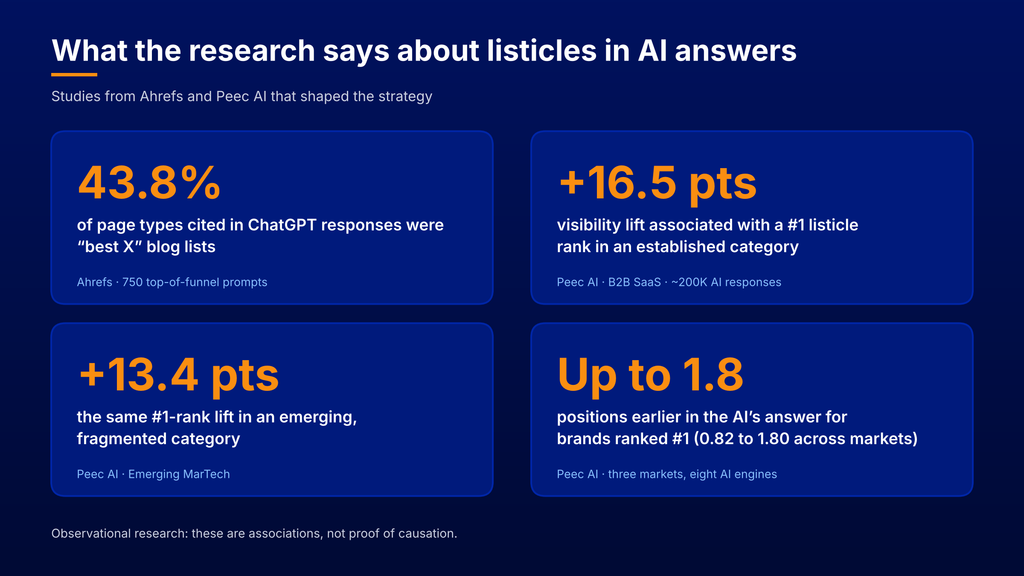
Listicles are among the most-cited page types. Ahrefs analyzed ChatGPT responses across 750 top-of-funnel prompts, including agency recommendations, and found that “best X” blog lists made up 43.8% of all cited page types. Comparison listicles also appeared among the most-cited pages on every major AI platform Ahrefs tracks through Brand Radar.
Position inside the list matters. Ahrefs found a clear trend toward brands that ranked higher in the lists ChatGPT sourced. Peec.ai’s study of nearly 200,000 AI responses (over 5.7 million data points across eight AI engines) tested this more rigorously. Brands exposed through frequently cited third-party listicles were significantly more likely to appear in AI answers, and a Rank 1 placement was associated with a visibility lift of up to 16.5 percentage points in established categories and 13.4 points in emerging ones. Peec also found that a #1 ranking consistently moved brands earlier in the AI’s answer in every market studied.
More is not always better. Peec found diminishing returns after a few repeated placements and advised winning the few listicles AI engines actually cite rather than chasing every one. That shaped our approach: a focused set of high-quality placements, not a volume play.
Third-party placements are the safer route. Peec’s analysis of 232,000 citations found that roughly 11% of citations came from self-promotional listicles, where a company ranks itself first on its own site. It cautioned against relying on them because of reputational and algorithmic risk. The client would be ranked #1 by independent publications, not by itself.
Our Hypothesis
If we publish “best of” listicles in high-end, niche publications that explicitly name the client as the #1 contractor, AI engines will begin citing those articles, and the client’s brand visibility and sentiment in AI answers will rise as a result.
We kept the target prompt, “I’m looking to hire a high-end commercial contractor NYC,” fixed and tracked it with Huginn across Perplexity, ChatGPT, Claude, and Gemini, so any change in visibility could be tied to the campaign.
Execution: Three Targeted Digital PR Placements
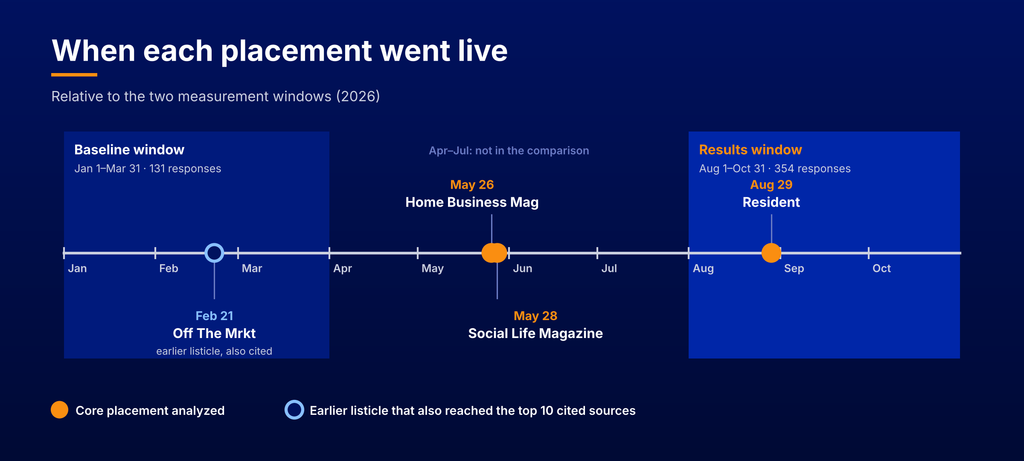
We secured three listicles in high-end niche publications, and each ranked the client #1. All three went live after the January to March baseline window closed.
| Publication | Listicle title | Published | List size |
| Home Business Mag | Top NYC Office Fit-Out Contractors | May 2026 | 5 |
| Social Life Magazine | Best General Contractors in NYC for Office Fit-Outs | May 28, 2026 | 6 |
| Resident | 7 NYC Commercial Contractors to Know for High-End Office Fit-Outs | Aug 29, 2026 | 7 |
Several choices made the set effective:
- Titles mirrored real buyer language. Phrases like “commercial contractors,” “NYC,” “office fit-outs,” and “high-end” match how prospects phrase their questions to an AI engine.
- Each placement sat on an independent third-party publication. This gave AI engines a trusted outside source instead of the client’s own claims.
- The set was deliberately small. Three placements reflected the diminishing-returns finding.
- The titles varied. Different phrasings gave the engines several ways to connect the client to the prompt.
Anatomy of the Placements
After publication, we audited the articles to see what AI engines would find when they retrieved them. The facts matched across independent sources, which gives engines corroboration:
| Message pillar | Where it appears |
| Insurance accepted by most NYC buildings (Action-Over, no Labor Law exclusion) and OSHA 62-Hour SST-certified supervisors | Home Business Mag, Social Life |
| Coverage of named Manhattan and Brooklyn neighborhoods | Home Business Mag, Social Life |
| High-end execution and design-intent fidelity | Home Business Mag, Social Life |
| Coordination with building management and tight tenant-improvement schedules | Home Business Mag, Social Life, Resident |
| Named brand clients and projects (Versace, Hyatt, Maison Kayser, L’Artusi, Zeta Global, and others) | Home Business Mag, Social Life |
The client also appeared alongside established names. Structure Tone and JRM appeared in both Home Business Mag and Social Life, and Shawmut in Home Business Mag. Those articles describe these firms as enterprise-scale, which positions the client as the high-end, design-driven alternative.
Finally, the articles link to the client’s homepage and its /offices page using descriptive anchor text such as “commercial office fit-outs.” That likely supports the client’s own site becoming the #1 cited source.
The Results & Impact
Brand visibility for the target prompt rose from 13% to 33.3%, and the client’s own website became the #1 cited source. From August 1 to October 31, 2026, Huginn analyzed 354 responses across Perplexity, ChatGPT, Claude, and Gemini and recorded 118 brand mentions. The mix of sources the engines relied on shifted as well, from a set of giant authority domains to one that included our placements and the client’s site.
Before and After
| Metric | Baseline (Jan 1 to Mar 31, 2026) | Results (Aug 1 to Oct 31, 2026) | Change |
| Responses analyzed | 131 | 354 | 2.7x the sample |
| Brand mentions | 17 | 118 | About 7x |
| Brand visibility | 13% | 33.3% | +20 points, about 2.6x |
| Positive sentiment | 12% | 24% | Doubled |
| Neutral sentiment | 88% | 76% | -12 points |
| Negative sentiment | 0% | 0% | No change |
What Changed
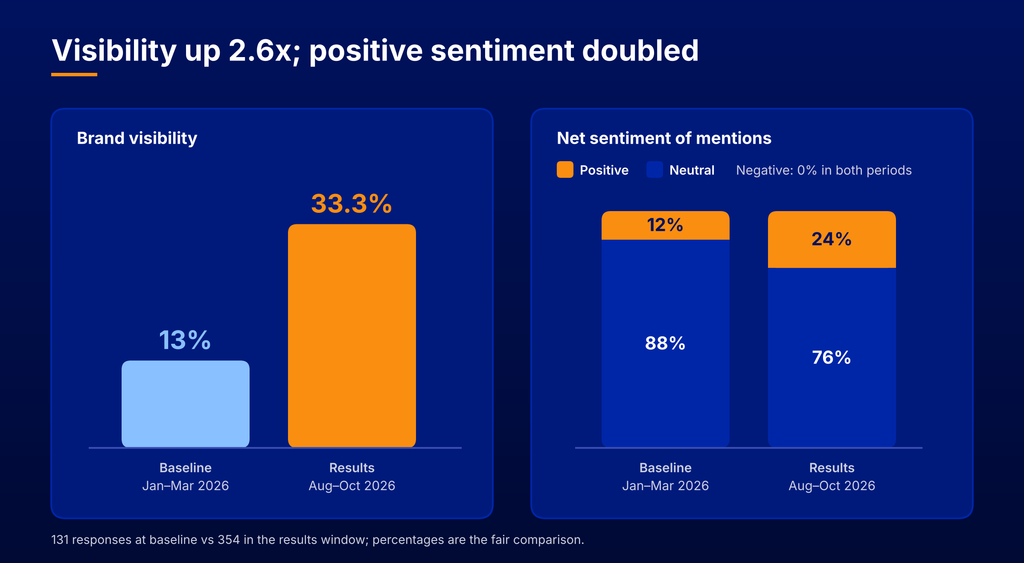
- Visibility more than doubled. The brand went from appearing in roughly 1 of every 8 answers to roughly 1 of every 3.
- Mentions grew faster than the sample. The number of analyzed responses rose 2.7x, while brand mentions rose about 7x, so the gain is not just a larger sample.
- Positive sentiment doubled. Share of positive sentiment moved from 12% to 24%, with neutral falling to 76%. Negative sentiment stayed at zero.
- The AI’s source mix shifted. In the baseline, the engines drew on NYC.gov, ENR, Turner Construction, Skanska, and Wikipedia. By the results window, our published listicles had broken into the top 10 sources cited for this prompt.
- The client’s website became the #1 source. Across the engines, the client’s own site was the most-cited source of information for the target prompt, ahead of the government and directory domains that dominated the baseline.
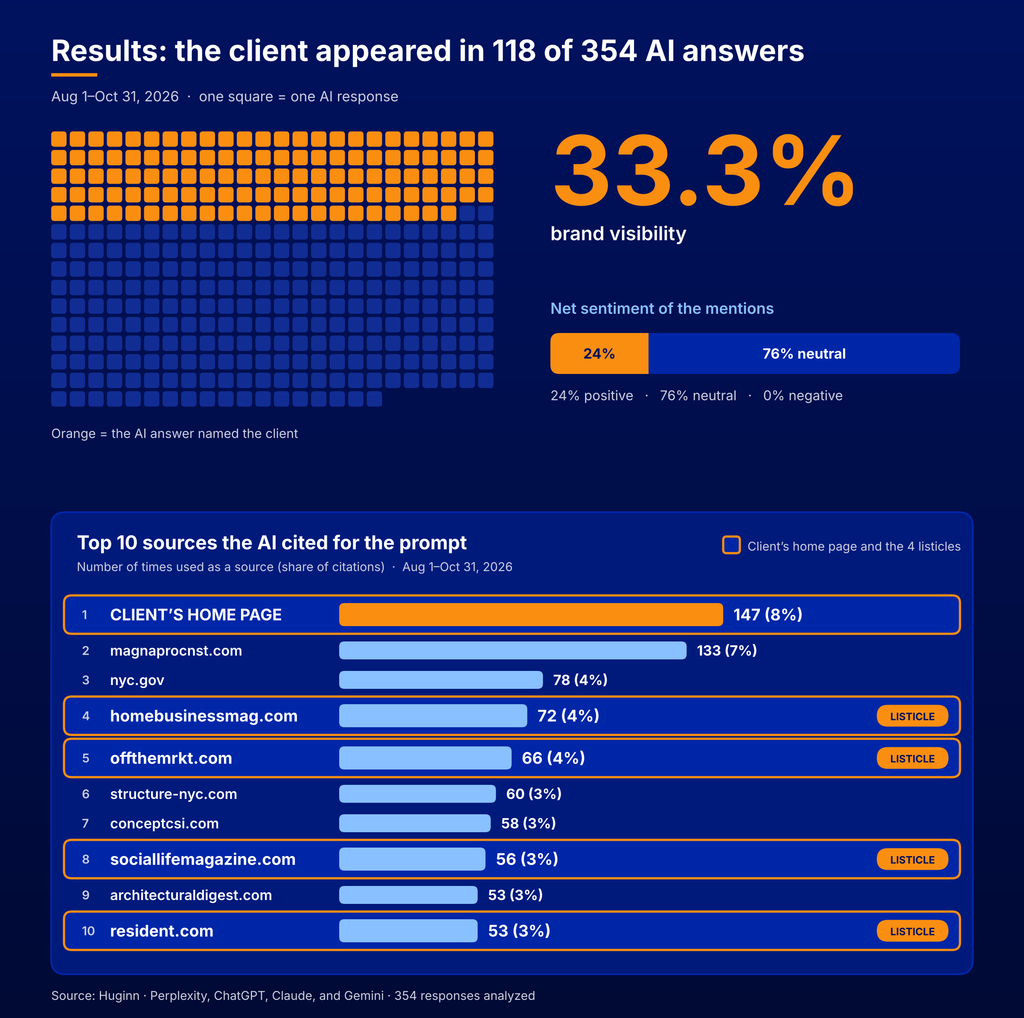
Observation: A Fourth Listicle Also Made the List
The Off The Mrkt article, Top Commercial Contractors in New York City, also appeared among the top 10 cited sources. It sits outside the three-placement set analyzed above because it was published earlier, on February 21, 2026. It ranks the client first among five contractors and pairs the list with practical buyer content, including cost-per-square-foot ranges, permit timelines, and an FAQ. Its appearance suggests that a listicle that also answers a buyer’s practical questions can earn citations alongside a straightforward ranking.
Because it went live inside the baseline window, the baseline was not entirely listicle-free, and the uplift above is measured from a starting point that already included one placement.
Beyond the Top Four
It is worth noting that while these four listicles became the most heavily cited by the AI engines, they were part of a broader Digital PR sprint. We published several other listicles across various niche publications during this same period. While they didn’t break into the AI’s top 10 source list for this specific prompt, they likely contributed to the overall entity saturation and authority signals that helped push the client’s own site to the #1 spot.
Golden Nuggets
Standard SEO is no longer enough, because AI engines decide which brands to name by weighing what trusted third parties say about them. Our client had the quality, yet before the campaign it appeared in only 13% of AI answers to a high-intent buying prompt. Ranking well on a results page does not guarantee a place in the answer, and the engines were drawing on NYC.gov, ENR, Turner, Skanska, and Wikipedia instead.
What changed the outcome was Digital PR. Ranked #1 in independent publications whose titles matched real buyer language, the client gave the engines the outside validation they were missing. Visibility rose to 33.3%, positive sentiment doubled to 24%, and the client’s own website became the #1 cited source. That fits the research behind the strategy: listicles are among the most-cited page types, and a top rank in them is associated with earlier, more prominent placement in AI answers.
It also changes what link building is for. A placement is no longer just a link that passes authority. It is a corroborating mention, with a rank, a consistent set of facts, and a link to the right page, that an engine can retrieve and repeat. As an observed result on one prompt, it shows association rather than proof of cause, but the direction is clear.
Key Takeaways
- Visibility is earned in the sources AI already cites. Winning a few relevant, high-quality placements beat chasing volume.
- Rank and relevance matter. Every placement ranked the client first, in a list whose title matched how buyers phrase the question.
- Third-party proof lifts the brand’s own site. After the placements, the client’s website became the most-cited source for the prompt.
- Track more than visibility. Sentiment, answer position, and which sources each engine cites show whether the gains are holding.
Closing
The brands AI engines recommend are increasingly the brands’ credible publications’ names. For firms in high-consideration categories, the question is no longer only where you rank, but who is vouching for you when the AI answers. To see where your brand stands today, start by tracking the prompts your buyers actually ask.
References:
- Do Self-Promotional “Best” Lists Boost ChatGPT Visibility? Study of 26,283 Source URLs | https://ahrefs.com/blog/best-lists-research/ | Glen Allsopp | Ryan Law – Reviewer | Published 12/4/2025
- The Listicle Rank Effect: What 200K AI Responses Across 8 AI Engines Reveal About Brand Visibility | https://peec.ai/blog/the-listicle-rank-effect-what-nearly-200-000-ai-responses-across-8-ai-engines-reveal-about-brand-visibility | Jan Ehrlinspiel | Published 05/14/2026
- Self-promotional listicles analysis: Data from 232,000 citations | https://peec.ai/blog/self-promotional-listicles-analysis-from-232k-citations |Tom Wells | Published 03/03/2026